Research Article | | Peer-Reviewed

A Robust Quantile Regression Model for Count Data: The Half Cauchy Transformation Approach

Received: 27 March 2025     Accepted: 7 April 2025     Published: 29 April 2025
Views:       Downloads:
Abstract

This paper introduces an innovative approach to modelling count data through the introduction of a robust quantile regression model, the Half Cauchy Quantile Regression (HCQR). Count data is frequently challenged by outliers and skewed distributions. By integrating the heavy-tailed properties of the Half Cauchy distribution into the quantile regression framework, the HCQR model offers reliable estimates, particularly in the presence of extreme values. Quantile regression models, including HCQR, typically exhibit greater robustness to such extremes compared to traditional methods. The study highlights the limitations of traditional count regression models, such as the Negative Binomial Regression (NBR), particularly their performance inadequacies within the quantile regression framework. A comparative analysis using real-world crime data illustrates that the HCQR model substantially outperforms the NBR model. By integrating the half Cauchy distribution into the quantile regression framework, the HCQR model was formulated. In the Half Cauchy Quantile Regression Model, the Half Cauchy quantile function is used to transform the traditional quantile regression outputs, accommodating the characteristics of the Half Cauchy distribution. This superiority is demonstrated through improved metrics such as lower Standard Deviation, Skewness, Kurtosis, Mean Squared Error (MSE), Root Mean Squared Error (RMSE), Mean Absolute Error (MAE), Akaike Information Criterion (AIC), and Bayesian Information Criterion (BIC), establishing HCQR's enhanced robustness and predictive accuracy.

Published in Science Journal of Applied Mathematics and Statistics (Volume 13, Issue 2)
DOI 10.11648/j.sjams.20251302.11
Page(s) 27-33
Creative Commons

This is an Open Access article, distributed under the terms of the Creative Commons Attribution 4.0 International License (http://creativecommons.org/licenses/by/4.0/), which permits unrestricted use, distribution and reproduction in any medium or format, provided the original work is properly cited.

Copyright

Copyright © The Author(s), 2025. Published by Science Publishing Group

Keywords

Quantile Regression Model, Count Regression, Half Cauchy Distribution, Half Cauchy Quantile Regression Model, Robustness to Extreme Values

1. Introduction
In traditional linear regression, the primary focus is on estimating the conditional mean of the response variable, which represents the center of the data distribution. However, this statistical regression approach often fails to capture important information about the tails of the distribution, particularly in the presence of extreme values. Quantile regression addresses this limitation by modelling the conditional quantiles of the response variable. This allows quantile regression to estimate a broader range of statistical relationships, capturing not only the central tendency of the response variable but also its behavior at various points in the data distribution. Quantile regression has gained recognition as a powerful tool for analyzing data beyond the mean, especially in the presence of outliers, skewness, and heavy-tailed distributions . However, existing quantile regression models often struggle to handle count response data, where outliers and extreme values are more pronounced . Traditional count regression models like Poisson and Negative Binomial regressions, while effective, may not adequately address the presence of extreme outliers in the data . This paper therefore presents the Half Cauchy Quantile Regression (HCQR) model, leveraging the robust properties of the Half Cauchy distribution. By incorporating the Half Cauchy distribution’s heavy-tailed nature in the quantile regression framework, the proposed HCQR model enhances the robustness of quantile regression, particularly when modeling count data with outliers.
Quantile regression, introduced by , extends traditional regression by estimating conditional quantiles instead of focusing solely on the conditional mean . It has been widely used to model data with heteroscedasticity, skewness, and extreme values . provided a comparative analysis of OLS and quantile regression, demonstrating that quantile regression offers more detailed insights into the impact of covariates across the entire distribution of response variables.
There has been a paradigm shift where several approaches have been introduced which focused on extending QR to handle data that departs from normality in regression models, especially when the response variable follows an asymmetrical distribution. proposed the Birnbaum-Saunders quantile regression using the Birnbaum-Saunders distribution. proposed a new quantile regression using the unit Birnbaum–Saunders distribution. proposed the Transmuted unit Rayleigh quantile regression model as an alternative to Beta and Kumaraswamy quantile regression models investigated the robustness of QR to outliers using a Cauchy transformation, proving its effectiveness in handling extreme values. Their study emphasized QR's superiority in providing robust estimations compared to traditional regression methods.
The Half Cauchy distribution is also one of such robust method, which is particularly suitable especially when the response variable follows a non-normal distribution that is a count data exhibiting a heavy-tailed nature. Previous research has demonstrated the effectiveness of using the Cauchy distribution in quantile regression , but the Half Cauchy distribution, a truncated version of the Cauchy distribution, is better suited for modeling count data.
Traditional count regression model, like Negative Binomial, assume specific distributions for count data. However, these models may struggle when the data exhibit extreme outliers. The proposed Half Cauchy Quantile regression (HCQR) model aims to overcome this limitation by incorporating the Half Cauchy distribution.
2. Material & Methods of Research
2.1. Count Regression Model - Negative Binomial Regression
Count data refers to data that represents the number of occurrences of an event within a specified time. In other words, count data are discrete (countable), non-negative integers (0, 1, 2, 3…) that represents the frequency of occurrence of an event or phenomenon.
Modelling count data with quantile regression can be more complex than other types of data due to its discrete nature, it’s restriction to non-negative values, and the presence of overdispersion. Count regression models are specialized statistical models designed to handle count data. These models are usually used when the response variable is a count, and we are interested in understanding the relationship between the count variables and one or more predictor variables. One commonly used count regression model is the Negative Binomial regression model.
In the context of modelling count data, Negative Binomial Regression (NBR) model is widely used to handle overdispersed data, where the variance exceeds the mean. It is particularly suited for situations where traditional Poisson regression, which assumes equal mean and variance, is inadequate. The NBR is a generalization of the Poisson model. In practice, count data often exhibits overdispersion, meaning that the variance is greater than the mean.
The Negative Binomial regression model is given as:
Log EYiX= β0+β1X1+β2X2++βpXp
here β0, β1,,βare the regression coefficients, and X1,X2,, Xp are the predictors.
2.2. Quantile Regression with Jittered Data
Quantile regression is a statistical technique that extends the capabilities of ordinary least regression by estimating the conditional quantiles of the response variable. However, quantile regression typically assumes that the response variable is continuous. The challenge with applying continuous quantile regression to count data is that count data is inherently discrete (i.e. it consists of integer values (0, 1, 2, 3…) while quantile regression models are designed for continuous data. When dealing with count data and the assumption is violated, then transformation is necessary to transform the data into a continuous form. One of such transformation is jittering, which simply involves adding some amount of noise to the count data.
Jittering is a simple technique where a small amount of random noise is added to the count data, making the data more continuous while still retaining the characteristics of the original count variable. For this study, the noise is drawn from a half Cauchy distribution.
Given that the response variable (Y) is count, (i.e. =y1,y2,,yn) where yi represents the count for the ith  observation, we apply jittering by adding a random noise ϵi which is drawn from the half Cauchy distribution. This transformed data Yjittered is given as:
Yjittered= Y+ ϵ
where ϵ=(ϵ1,ϵ2,,ϵn) are the jittering noise values, drawn from the half Cauchy distribution.
For each observation yi, the jittered data takes the form,
yijittered =yi+ ϵi
where ϵi ~ Half Cauchy. This means that each ϵi is a random value drawn from the Half Cauchy distribution. To ensure that the transformed values are non-negative, we use the condition:
yijittered =max(yi+ ϵi,0)
This condition ensures that the jittered data remains non negative (as count data cannot be negative).
2.3. Half Cauchy Distribution
The half Cauchy distribution is the folded (truncated) form of the standard Cauchy distribution around the origin so that only positive (nonnegative) values are observed and detected. The half-Cauchy distribution is a heavy-tailed distribution characterized by its robustness against outliers, making it suitable for modeling data with extreme values.
The probability density function (PDF) of the half-Cauchy distribution is given by:
f(x:σ)=2πσ  1+x-θσ 2-1;x>0
θ is the location parameter (center of the peak)
σ is the scale parameter (controls the width of the distribution)
when θ=0 and σ=1, we have a standard Half Cauchy distribution as
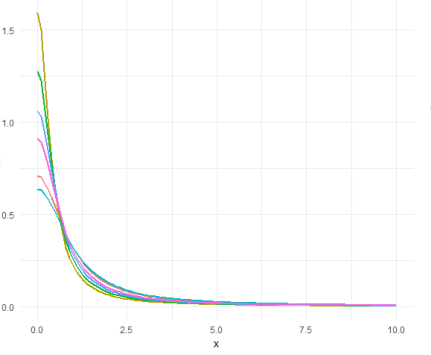
fx= 2π11+x2
Figure 1. Half Cauchy Distribution Probability Density Function plot.
The cumulative distribution function (CDF) can be expressed as:
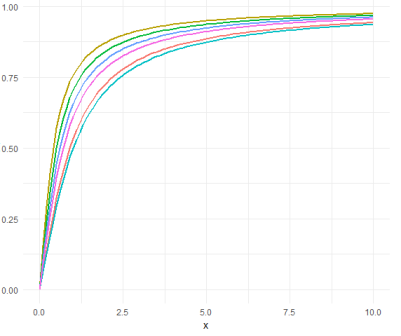
Fx=2πarctanx, x0
Figure 2. Half Cauchy Distribution Cumulative Density Function plot.
Inverse CDF (Quantile Function): The quantile function (i.e. Q(p)) is the inverse of the CDF, solving for x in terms of the cumulative probability p = F(x), where [0,1].
Qp=tanπ2p,(0p1)
Since Q(p) = tanπ2p for 0p1, then let τ be the quantiles in quantile regression, where 0τ1. We can now relate equation as:
Qτ=tanπ2τ (0τ1)
The proposed HCQR model extends traditional quantile regression by integrating the Half Cauchy distribution’s quantile function. The mathematical formulation involves transforming the response variable using the quantile function of the Half Cauchy distribution, which allows for robust estimation of the conditional quantiles.
Qτ= QτYX
tanπ 2τ =β0(τ)+β1(τ)X1+β2(τ)X2++βpτXp
to solve for τ, we apply the inverse tangent (arctangent) function to both sides of the equation to get:
π 2τ =arctan(β0(τ)+β1(τ)X1+β2(τ)X2++βpτXp)
solve for τ by multiplying both sides of the equation by 2 π to get:
τ=2πarctan(β0(τ)+β1(τ)X1+β2(τ)X2++βpτXp)
recall that τ is the quantile range where τ[0,1] which essentially corresponds to the cumulative probability (quantiles) based on the predictors X1, X2,,Xp and their coefficient β0(τ),β1(τ),β2(τ),βp(τ).
Since τ represents a quantile, it can be expressed as Q(τ), representing the quantile function. Therefore, we can rewrite the above equation 43 as:
Qτ = 2πarctan(β0(τ)+β1(τ)X1+β2(τ)X2++βpτXp)
Now, the quantile function Qyτ for the response variable Y similarly relates to the quantile function Qτ.
The regression model can be expressed as follows:
QτY= 2πarctan(β0(τ)+β1(τ)X1+β2(τ)X2++βpτXp)
QτY = the τth quantile of the response variable Y to be estimated.
X1, X2,,Xp = The predictor variables (independent variables) that influence the quantile of the response variable Y.
β0τ = The intercept (slope) term for the quantile regression model at quantile τ.
β1(τ),β2(τ),βp(τ) = The regression coefficients for the predictor variables at quantile τ
τ = specified quantiles of the model (0.05, 0.25, 0.50, 0.75, 0.95)
The proposed half Cauchy quantile regression model will be applied on a jittered count (discrete) data as well as manage extreme values and outliers.
3. Results
A detailed comparison and discussion of the results obtained from the implementation of the Negative Binomial Regression (NBR) model and the proposed Half Cauchy Quantile Regression (HCQR) model was applied to a real life (crime data) where factors such as population density, income level, unemployment rate and police presence was used to investigate contributing factors to rise of crime rate. The above-mentioned models are evaluated based on results obtained on their model diagnostics including Mean Squared Error (MSE), Root Mean Squared Error (RMSE), Mean Absolute Error (MAE), Skewness, Kurtosis, Standard Deviation, Akaike Information Criterion (AIC) and Bayesian Information Criterion (BIC).
Table 1. Model Comparison for NBR, CQR and proposed HCQR for the jittered data.

Model

MSE

RMSE

MAE

Skewness

Kurtosis

Standard Deviation

AIC

BIC

Negative Binomial Regression

104.837

10.239

5.755

8.220

75.270

10.293

3004.587

3190.536

Half Cauchy Quantile Regression

0.05

95.969

9.796

3.147

7.245

68.616

9.289

2973.108

2993.066

0.25

96.044

9.800

3.190

7.218

68.284

9.283

2973.510

2993.467

0.50

93.296

9.659

2.982

7.220

68.392

9.287

2960.729

2980.686

0.75

91.823

9.582

2.862

7.248

68.688

9.286

2953.902

2973.859

0.95

90.245

9.500

2.773

7.303

69.549

9.260

2946.694

2966.651

4. Discussion
The table above presents a comparison of the Negative binomial regression (NBR) and the proposed Half-Cauchy quantile regression (HCQR Each metric evaluates the model’s performance with specific quantiles highlighted, leading to a holistic view of model accuracy, error distribution and fit quality. The MSE, RMSE and MAE values of the proposed model is lower than that of the NBR, suggesting it predicts with the least error, gives slightly more precise prediction under this model and performs well across different sections of the data compared to the Negative Binomial Regression model. Also, the skewness and kurtosis value for the proposed model is lower compared to the Negative Binomial Regression model. This suggests and reveals a more asymmetric error distribution of the data, leading to a more reliable prediction having heavy tails with fewer extreme values or outliers in its prediction. The proposed model has lower values in the standard deviation as compared with the other models considered in the study, indicating more closeness to the median (mean). Finally, the AIC and BIC values for the proposed model is also observed to be lower than the Negative Binomial Regression model. This indicates that it provides a better balance between model goodness of fit and performance. Across all metrics, the proposed Half Cauchy quantile regression model consistently outperforms the performance of the Negative Binomial Regression model, especially at higher quantiles which are crucial for understanding extremes values (outliers) in life data. This suggest that the Half Cauchy quantile regression model can be particularly effective in applications were predicting outliers (extreme value) accurately is crucial especially when the error distribution follows a non-normal distribution.
5. Conclusion
From the analysis conducted, the proposed HCQR model formulated with the Half Cauchy distribution, was found have performed well in handling count (discrete) and robust against extreme values (outliers). The proposed model's performance evaluations demonstrated the superior robustness of HCQR compared to Negative Binomial regression model. The performance metrics such as RMSE, MSE, MAE, AIC, BIC, Skewness, Kurtosis and standard deviation demonstrated the robustness and suitability of the proposed HCQR model in handling count (discrete) data. The proposed HCQR model outperformed the Negative Binomial Regression model in terms of robustness and goodness-of-fit, particularly in challenging datasets.
This study also demonstrates the potentials of the proposed HCQR in addressing critical gaps in statistically modeling count (discrete) data, laying a foundation for broader adoption in statistical and applied research.
6. Recommendations
Based on outcomes presented in the results obtained, we recommend that researchers working with count data are encouraged to consider the half Cauchy quantile regression model, especially in situations where traditional count regression models fail to account for outliers present in the count data. The proposed HCQR model’s robustness makes it a strong alternative for handling real world datasets where heavy – tailed distributions are present.
Also, researchers are encouraged to refine and extend the framework, particularly by introducing Bayesian methods for parameter estimation. Expanding the model will make it more applicable to a wider range of real-world dataset.
Abbreviations

OLS

Ordinary Least Squares

NBR

Negative Binomial Regression

CQR

Cauchit Quantile Regression

HCQR

Half Cauchy Quantile Regression

MSE

Mean Square Error

MAE

Mean Absolute Error

RMSE

Root Mean Square Error

AIC

Akaike Information Criteria

BIC

Bayesian Information Criterion

Acknowledgments
We express our profound gratitude to the referees, the associate editor, and the consulting editor for their invaluable contributions to this work. Their meticulous and insightful comments have significantly enhanced the quality of our manuscript. This research has been enriched by their rigorous reviews and thoughtful feedback, for which we are deeply appreciative.
Author Contributions
Runyi Emmanuel Francis: Conceptualization, Data curation, Formal Analysis, Investigation, Methodology, Project administration, Resources, Software, Writing – original draft
Maureen Tobe Nwakuya: Conceptualization, Data curation, Formal Analysis, Investigation, Methodology, Project administration, Resources, Software, Writing – original draft
Maxwell Azubuike Ijomah: Methodology, Supervision, Validation, Writing – review & editing
Funding
The authors wish to clarify that there was no external funding received for this research. All aspects of this study were conducted independently and without financial support from any grants or sponsorship entities.
Conflicts of Interest
The authors declare no conflicts of interest.
References
[1] Acquah, H. D. (2018). Comparing OLS and quantile regression estimation techniques for production analysis: An application to Ghanaian maize farms. RJOAS, 8(80), 388.
[2] Allen, D. E., Gerrans, P., Powell, R., & Singh, A. K. (2009). Quantile regression: its application in investment analysis. Jassa, (4), 7-12.
[3] Congdon, P. (2017). Quantile regression for overdispersed count data: A hierarchical method. Journal of Statistical Distributions and Applications, 4(18).
[4] Francis, R. E., & Nwakuya, M. T. (2022). A comparative analysis of ordinary least squares and quantile regression estimation technique. American Journal of Mathematical and Computer Modelling, 7(4), 49-54.
[5] Hao, L., & Naiman, D. Q. (2007). Quantile regression. SAGE Publications, Inc.,
[6] Koenker, R. (2004). Quantile regression for longitudinal data. Journal of Multivariate Analysis, 91(1), 74-89.
[7] Koenker, R., & Bassett Jr, G. (1978). Regression quantiles. Econometrica: Journal of the Econometric Society, 46(1), 33-50.
[8] Koenker, R., & Mizera, I. (2004). Penalized trigrams: Total variation regularization for bivariate smoothing. Journal of the Royal Statistical Society: Series B (Statistical Methodology), 66(1), 145-163.
[9] Korkmaz, M. Ç., Chesneau, C., & Korkmaz, Z. S. (2021). Transmuted unit Rayleigh quantile regression model: Alternative to beta and Kumaraswamy quantile regression models. UPB Scientific Bulletin, Series A: Applied Mathematics and Physics 83(3): 149-158.
[10] Leiva, V., Sánchez, L., Galea, M., & Saulo, H. (2020). Birnbaum-Saunders quantile regression and its diagnostics with application to economic data. Applied Stochastic Models in Business and Industry, 36(5), 956-973.
[11] Machado, J., & Santos Silva, J. (2005). Quantiles for counts. Journal of the American Statistical Association, 100(472), 1226-1237.
[12] Mazucheli, J., Leiva, V., Alves, B., & Menezes, A. (2021). A new quantile regression for modeling bounded data under a unit Birnbaum–Saunders distribution with applications in medicine and politics. Symmetry, 13(4), 682.
[13] Nwabueze, C. J., Onyegbuchulem, B. O, & Nwakuya, M. T. (2022). On the Equivariance of Location Reparameterization of Quantile Regression Model using Cauchy Transformation. Mathematical Theory and Modeling, 12(2), 2022.
[14] Nwabueze, J. C., Onyegbuchulem, B. O., Nwakuya, M. T., & Onyegbuchulem, C. A. (2021). A Cauchy transformation approach to the robustness of quantile regression model to outliers. Royal Statistical Society Nigeria Local Group Conference Proceedings, 2021.
Cite This Article
  • APA Style

    Francis, R. E., Nwakuya, M. T., Ijomah, M. A. (2025). A Robust Quantile Regression Model for Count Data: The Half Cauchy Transformation Approach. Science Journal of Applied Mathematics and Statistics, 13(2), 27-33. https://doi.org/10.11648/j.sjams.20251302.11

    Copy | Download

    ACS Style

    Francis, R. E.; Nwakuya, M. T.; Ijomah, M. A. A Robust Quantile Regression Model for Count Data: The Half Cauchy Transformation Approach. Sci. J. Appl. Math. Stat. 2025, 13(2), 27-33. doi: 10.11648/j.sjams.20251302.11

    Copy | Download

    AMA Style

    Francis RE, Nwakuya MT, Ijomah MA. A Robust Quantile Regression Model for Count Data: The Half Cauchy Transformation Approach. Sci J Appl Math Stat. 2025;13(2):27-33. doi: 10.11648/j.sjams.20251302.11

    Copy | Download

  • @article{10.11648/j.sjams.20251302.11,
      author = {Runyi Emmanuel Francis and Maureen Tobe Nwakuya and Maxwell Azubuike Ijomah},
      title = {A Robust Quantile Regression Model for Count Data: The Half Cauchy Transformation Approach
    },
      journal = {Science Journal of Applied Mathematics and Statistics},
      volume = {13},
      number = {2},
      pages = {27-33},
      doi = {10.11648/j.sjams.20251302.11},
      url = {https://doi.org/10.11648/j.sjams.20251302.11},
      eprint = {https://article.sciencepublishinggroup.com/pdf/10.11648.j.sjams.20251302.11},
      abstract = {This paper introduces an innovative approach to modelling count data through the introduction of a robust quantile regression model, the Half Cauchy Quantile Regression (HCQR). Count data is frequently challenged by outliers and skewed distributions. By integrating the heavy-tailed properties of the Half Cauchy distribution into the quantile regression framework, the HCQR model offers reliable estimates, particularly in the presence of extreme values. Quantile regression models, including HCQR, typically exhibit greater robustness to such extremes compared to traditional methods. The study highlights the limitations of traditional count regression models, such as the Negative Binomial Regression (NBR), particularly their performance inadequacies within the quantile regression framework. A comparative analysis using real-world crime data illustrates that the HCQR model substantially outperforms the NBR model. By integrating the half Cauchy distribution into the quantile regression framework, the HCQR model was formulated. In the Half Cauchy Quantile Regression Model, the Half Cauchy quantile function is used to transform the traditional quantile regression outputs, accommodating the characteristics of the Half Cauchy distribution. This superiority is demonstrated through improved metrics such as lower Standard Deviation, Skewness, Kurtosis, Mean Squared Error (MSE), Root Mean Squared Error (RMSE), Mean Absolute Error (MAE), Akaike Information Criterion (AIC), and Bayesian Information Criterion (BIC), establishing HCQR's enhanced robustness and predictive accuracy.
    },
     year = {2025}
    }
    

    Copy | Download

  • TY  - JOUR
    T1  - A Robust Quantile Regression Model for Count Data: The Half Cauchy Transformation Approach
    
    AU  - Runyi Emmanuel Francis
    AU  - Maureen Tobe Nwakuya
    AU  - Maxwell Azubuike Ijomah
    Y1  - 2025/04/29
    PY  - 2025
    N1  - https://doi.org/10.11648/j.sjams.20251302.11
    DO  - 10.11648/j.sjams.20251302.11
    T2  - Science Journal of Applied Mathematics and Statistics
    JF  - Science Journal of Applied Mathematics and Statistics
    JO  - Science Journal of Applied Mathematics and Statistics
    SP  - 27
    EP  - 33
    PB  - Science Publishing Group
    SN  - 2376-9513
    UR  - https://doi.org/10.11648/j.sjams.20251302.11
    AB  - This paper introduces an innovative approach to modelling count data through the introduction of a robust quantile regression model, the Half Cauchy Quantile Regression (HCQR). Count data is frequently challenged by outliers and skewed distributions. By integrating the heavy-tailed properties of the Half Cauchy distribution into the quantile regression framework, the HCQR model offers reliable estimates, particularly in the presence of extreme values. Quantile regression models, including HCQR, typically exhibit greater robustness to such extremes compared to traditional methods. The study highlights the limitations of traditional count regression models, such as the Negative Binomial Regression (NBR), particularly their performance inadequacies within the quantile regression framework. A comparative analysis using real-world crime data illustrates that the HCQR model substantially outperforms the NBR model. By integrating the half Cauchy distribution into the quantile regression framework, the HCQR model was formulated. In the Half Cauchy Quantile Regression Model, the Half Cauchy quantile function is used to transform the traditional quantile regression outputs, accommodating the characteristics of the Half Cauchy distribution. This superiority is demonstrated through improved metrics such as lower Standard Deviation, Skewness, Kurtosis, Mean Squared Error (MSE), Root Mean Squared Error (RMSE), Mean Absolute Error (MAE), Akaike Information Criterion (AIC), and Bayesian Information Criterion (BIC), establishing HCQR's enhanced robustness and predictive accuracy.
    
    VL  - 13
    IS  - 2
    ER  - 

    Copy | Download

Author Information